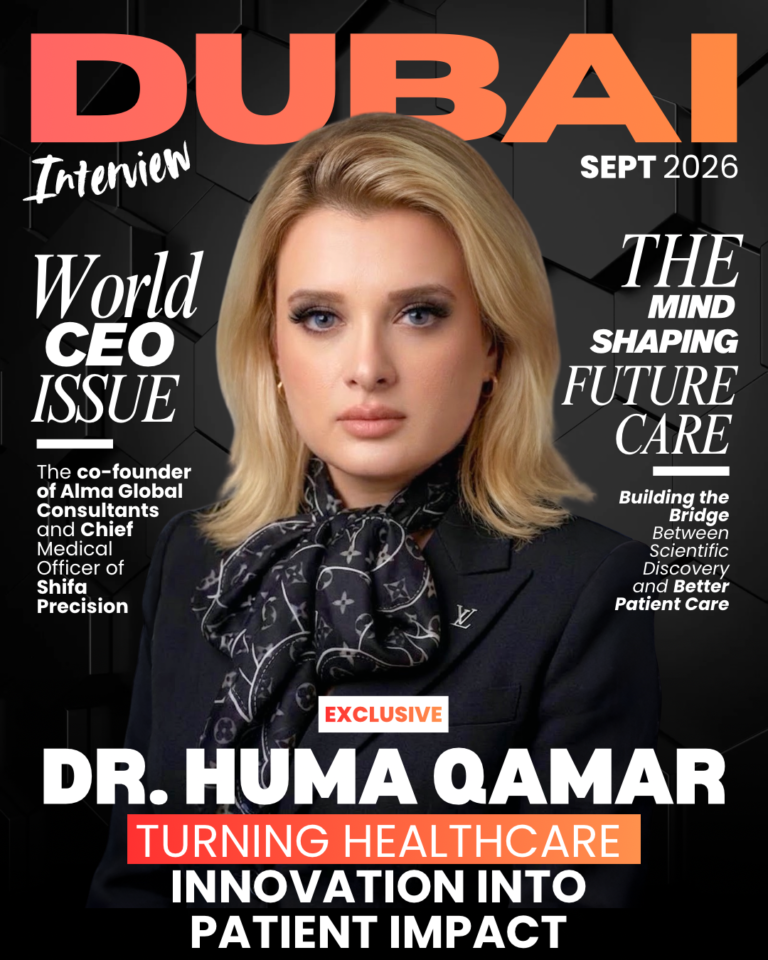
A promising treatment can lose years between a laboratory discovery and the patient waiting for it. Dr. Huma Qamar has spent much of her career confronting what happens in that interval.
Across medicine, clinical development and biotechnology leadership, she has repeatedly seen scientific potential held back by fragmented decisions, weak execution and a disconnect from clinical practice. That experience now informs her work at Alma Global Consultants, the advisory business she co-founded with Alfredo Garcia, its President and Chief Financial Officer.
“The problem I’m determined to solve is the translation gap between innovation and impact,” she says.
For healthcare leaders and investors in Dubai and the wider UAE, Qamar brings a practical argument: ambition needs clinical infrastructure capable of carrying it through to patients.
A purpose formed in Pakistan
Qamar traces her interest in medicine to a military hospital corridor in Rawalpindi. Watching the limits placed on good clinical judgment by inadequate infrastructure shaped an ambition that extended beyond treating individual patients.
She wanted to improve the systems through which care reached them.
Her experience treating earthquake survivors in Pakistan deepened that resolve. Working with limited resources and making urgent triage decisions gave her a lasting sense of what delays mean to people whose health cannot wait.
That urgency followed her into biotechnology leadership in the United States. Clinical development offered the possibility of helping patients far beyond those she could personally see, provided promising programs could move through the complex work required to reach them.
“I went into leadership because I got tired of watching promising science die in translation,” she explains.
The business behind the breakthrough
Alma Global Consultants grew out of that recurring problem. Qamar saw companies developing compelling innovations without always having the strategy, coordination or understanding of healthcare delivery needed to make them useful.
The firm brings clinical expertise, drug development experience and AI strategy together. Its work, as she describes it, includes helping biotechnology companies design clinical programs, guiding healthcare organizations through AI adoption and advising on market strategy.
AI has made the need for that guidance more pressing. In Qamar’s view, many healthcare organizations understand that they must respond to the technology but lack a clear roadmap for adopting it responsibly and within the requirements of their operating environment.
For Alma, the work begins with the clinical problem and the decisions an organization needs to make. An AI strategy must connect to how care is delivered, how evidence is evaluated and how teams put new tools into practice.
Whether the assignment concerns a clinical program or a health system’s use of AI, she describes the goal in the same terms: “shorten the distance between a good idea and a patient who benefits from it.”
What gene therapy taught her about execution
Qamar’s experience across ophthalmology, gene and cell therapy, and vaccines has reinforced her belief that coordination can determine whether a program advances.
She describes the strongest teams as those in which regulatory specialists, clinical operations, clinical development and medical affairs work toward a shared objective. Each discipline contributes something essential; problems emerge when decisions remain isolated within departments.
“Science doesn’t heal anyone until someone builds the bridge it has to walk across,” she says.
Her work with retinal conditions, including retinitis pigmentosa and Stargardt disease, has also kept her focused on the individual behind a development milestone. For someone living with deteriorating vision, a delay is time they cannot recover.
Asked about the achievement that matters most to her, Qamar turns to team building. She takes particular pride in developing and retaining clinical teams while managing programs across multiple trial phases. The trust that keeps people working together through difficult periods, she believes, makes the scientific work possible.
Making AI useful in the examination room
Qamar approaches the same challenge from another direction as Chief Medical Officer of Shifa Precision, where her focus includes making emerging health insights useful to physicians.
She describes the company’s OASIS AI platform as bringing together genomics, biomarkers, microbiome information and clinical history to create a Molecular Twin™. The aim is to help clinicians recognize developing health risks earlier and consider appropriate next steps.
Her priority is the connection between that information and a clinical decision. A physician needs to understand what a signal means and whether the evidence supports acting on it.
“My job there is making sure that intelligence is something a physician can actually act on in an exam room,” she says.
The ambition reflects a lesson from her gene therapy work: the interval between the first sign of a problem and a clear diagnosis can carry significant consequences. At Shifa Precision, she wants to help address that interval earlier in the patient’s care.
The opportunity she sees in the UAE
Qamar sees considerable potential for the UAE to advance precision medicine and clinical research. She points to its capital, international connections and capacity to bring institutions together as foundations on which further clinical capability could be built.
Her emphasis is on the practical requirements of running trials: experienced research teams, hospitals prepared to conduct studies, specialist networks and dependable clinical operations.
“I want partnerships that treat clinical trial infrastructure as seriously as this region has treated financial infrastructure,” she says.
The partners she hopes to work with include academic medical centres building research operations, investors prepared for biotechnology’s development timelines and health authorities willing to engage throughout the process.
She is particularly interested in opportunities involving rare disease and ophthalmology, and in research that includes populations she regards as insufficiently represented in global studies. For her, regional participation should shape how programs are designed from the beginning.
That ambition extends to South Asia and parts of Africa. Qamar would like to see diagnostic and trial-matching tools developed with local clinicians, hospitals and health ministries, using local knowledge and data to address local disease burdens. She also sees potential for AI to support patient identification and monitoring in more geographically distributed trials.
These are areas she wants to help build through partnerships, with the people delivering care involved in the design.
Leadership that gives the work a voice
Qamar’s advice to women aspiring to senior roles in medicine and biotechnology comes from her experience of being underestimated in rooms where major development decisions were made.
Expertise matters, she says, but leaders must also be prepared to speak while a decision can still be influenced. That may mean identifying a delay, correcting an assumption or making the consequences of a choice clear.
“The lesson isn’t ‘work twice as hard.’ It’s ‘speak twice as early.’”
Her longer ambition remains rooted in patients whose conditions can struggle to attract sustained commercial attention. She wants a future in which the rarity of a disease does not determine whether someone has a treatment available.
“I want the phrase ‘orphan disease’ to stop meaning ‘orphaned by industry,’” she says.
That is the test she brings to her work in clinical development, AI and advisory services: whether the strategy being built today gives a patient a better chance of receiving care tomorrow.