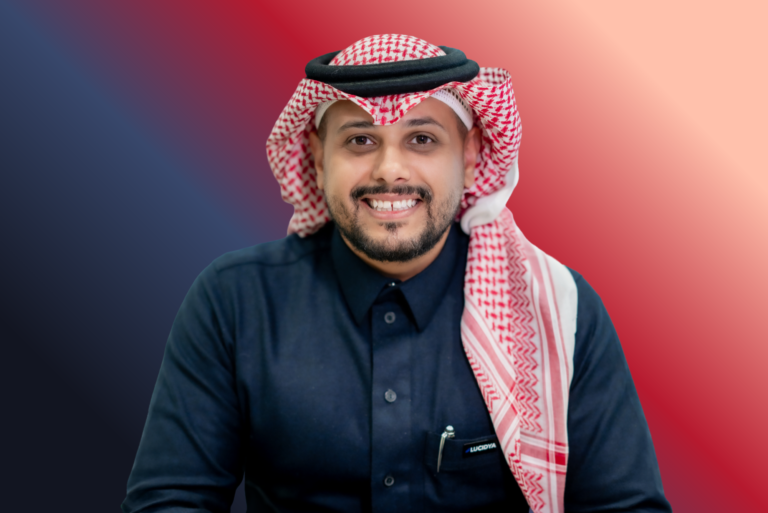
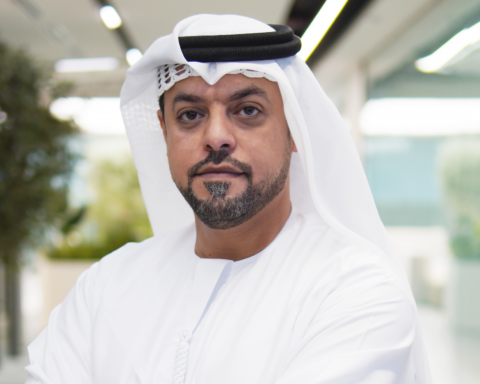
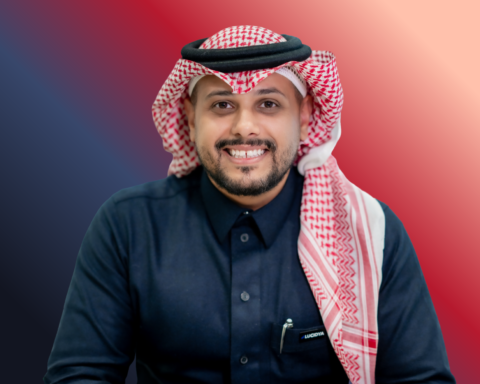
Abdullah Asiri has spent nearly a decade building Lucidya around an idea that was relatively unconventional when the company was founded in 2016: Arabic should not be an additional feature added to an English-first technology platform. It should be the foundation of the product.
Founded in Jeddah by Asiri alongside Hatem Kameli, Mohamed Milyani and Zuhair Khayyat, Lucidya has developed into an artificial intelligence company focused on customer experience and intelligence. The company now serves customers across 13 countries and industries ranging from banking and government to travel, insurance and logistics.
The company has also been recognised by Frost & Sullivan as a category leader in AI-powered customer experience.
At the centre of Lucidya’s proposition is an Arabic-first technology strategy that combines customer intelligence, social listening, media monitoring, customer profiling, surveys and omnichannel engagement through its OmniServe solution.
The company says its proprietary models cover 17 Arabic dialects, from Khaliji to Maghrebi, and that its technology has been built using years of regional-language data.
For Asiri, that accumulated data represents one of Lucidya’s most important competitive assets.
“Arabic was the product, not a feature,” Asiri said, describing one of the decisions that most significantly shaped the company’s trajectory.
When Lucidya was established, building an English-language product and adding Arabic support later would have been a simpler and potentially cheaper route. Instead, the company chose to build around Arabic from the beginning.
Asiri says the strategy resulted in almost 10 years of Arabic conversation data and more than 10 billion public posts, with models trained across 17 sub-dialects.
The company argues that this long-term investment gives its technology an advantage in understanding regional language, context and customer behaviour.
For Asiri, the significance of the decision is that the advantage compounds over time. Every additional interaction can potentially contribute to better models and, in turn, improve the product.
“Arabic-first is the only one of the four that compounds while I sleep,” he said.
FROM FOUNDER-LED SURVIVAL TO ORGANISATIONAL LEADERSHIP
Asiri says Lucidya’s growth has forced him to change his leadership style repeatedly.
During the company’s early years, he was involved in almost every aspect of the business, from writing sales pitches and attending customer meetings to discussing model accuracy with engineers.
He describes that period as a matter of survival rather than a deliberate management philosophy.
The first major leadership transition came around 2022 and 2023, when Lucidya expanded beyond its original social-listening product.
The company launched OmniServe, bringing together customer data and engagement capabilities, within roughly 12 months. Revenue subsequently increased, but Asiri says the more significant change was internal.
He could no longer personally understand every part of the organisation.
That forced him to redefine his role from making individual decisions to building an organisation capable of making good decisions without him.
Lucidya subsequently brought experienced executives into senior positions, including leaders with experience managing finance, engineering and revenue operations at much larger companies.
Asiri says hiring experienced executives was easier than learning to give them genuine autonomy.
He acknowledged that his instinct had often been to hear a problem and immediately provide an answer.
That approach, he said, could discourage employees from developing and presenting their own thinking.
Influenced in part by Liz Wiseman’s book “Multipliers”, Asiri describes himself as having been an “accidental diminisher” and says he now tries to lead with questions rather than immediate answers.
His internal rule is that if another person can make a decision at roughly 70 per cent of his quality, they should make it.
His own attention, he says, should be reserved for the relatively small number of decisions that only the CEO can make.
The next leadership challenge is being created by agentic AI itself.
As Lucidya develops AI systems capable of taking action rather than simply generating insights, Asiri believes the company is being forced to reconsider its own customer-service model and organisational structure.
FROM CUSTOMER INTELLIGENCE TO ACTION
Lucidya’s evolution mirrors a broader shift taking place across the AI industry.
For much of its history, the company’s technology focused on understanding what customers were saying, identifying sentiment and finding emerging problems.
The next stage is designed to move beyond analysis.
Asiri describes Lucidya’s Agentic CX approach as a shift from answering questions to taking action.
The company’s AI agents are designed to resolve customer cases within clients’ existing systems, subject to policy controls and audit trails, while escalating cases to human employees when required.
Asiri cited one five-month deployment in which an AI agent handled approximately 85 per cent of eligible cases without human intervention and removed roughly 6,000 hours of work from the relevant team.
For Asiri, the significance of such deployments is not simply that they demonstrate AI capability.
Instead, he sees agentic AI as a potential redesign of how organisations structure customer service.
He argues that companies purchasing AI as another technology tool risk adding another layer to existing workflows without fundamentally changing how work gets done.
The larger opportunity, in his view, comes when organisations redesign processes around what AI systems can actually execute.
He believes companies should begin with measurable operational problems rather than broad ambitions to “do something with AI”.
Metrics such as cost per contact, backlog, resolution time and first-response service levels can provide clearer benchmarks for determining whether an AI deployment is generating tangible value.
Another important factor is the level of authority given to AI.
Asiri argues that AI systems capable only of communicating but not acting can leave the most important part of the workflow unchanged.
If an AI agent can communicate with a customer but cannot update a CRM system or complete an authorised transaction, a human employee may still have to perform the underlying task.
In such cases, automation may reduce part of the workload without eliminating the process itself.
Asiri therefore believes governance and access controls need to be considered at the beginning of an AI project rather than added after deployment.
SAUDI ARABIA AS A GLOBAL TECHNOLOGY BASE
Asiri’s ambitions for Lucidya extend well beyond Saudi Arabia.
He believes the next generation of Saudi technology companies will have to compete internationally on capability rather than market access or relationships.
Global technology companies are already competing directly in Saudi Arabia, creating a more demanding environment for local technology businesses.
For Asiri, that competition is positive because it forces Saudi companies to demonstrate that their products can compete on measurable performance.
His ambition dates back to 2011, when he started his first company after returning from the United States.
He says his goal was not simply to build a successful Saudi company serving Saudi customers but to build technology in Saudi Arabia that could eventually be exported around the world.
Lucidya’s international expansion is now testing that ambition.
The company serves customers across 13 countries, including the United Kingdom and the United States, and has established a sales presence in the US.
Asiri remains cautious about describing the American expansion as an established success.
Instead, he describes it as an early and difficult test of whether Lucidya can compete without relying on the advantages of its home market.
The company’s proposition in international markets is therefore centred on product capability.
Asiri argues that if Lucidya can remain competitive after removing the Saudi identity from the equation, the company will have demonstrated that it has built a genuinely global technology business.
THE INTERNATIONAL EXPANSION STRATEGY
Asiri is also cautious about expanding internationally simply for the sake of geographic growth.
He believes companies can move abroad too early because international expansion can look attractive in board presentations while distracting management from more fundamental challenges.
Lucidya uses a staged approach involving exploration, testing, validation and eventual scaling.
The company divides potential markets into three broad groups.
The Gulf is treated as an extension of its home market because of shared language, regional relationships and overlapping enterprise customers.
The United States represents a different kind of test because there is little opportunity to rely on regional familiarity or proximity.
Lucidya is approaching the US with a product-led strategy, allowing customers to evaluate the technology and demonstrate value before expanding the relationship.
The wider Middle East and North Africa region is being approached more cautiously, with investment driven by demonstrated market demand rather than expansion targets alone.
Asiri says four questions influence Lucidya’s international decisions: whether genuine customer demand exists, whether the company can compete on capability, whether management has sufficient capacity to enter the market without weakening the core business, and whether expansion strengthens more than one part of the company.
He believes the strongest international moves should generate more than revenue.
They should also strengthen the product, improve credibility, provide access to talent or make subsequent market entry easier.
COMPETING THROUGH ARABIC AI
Arabic remains at the centre of Lucidya’s international proposition.
Asiri argues that Arabic should not be considered a small technology niche because more than 400 million people speak the language.
Historically, many technology products have been developed primarily for English-language users and adapted for Arabic-speaking markets later.
Lucidya has attempted to reverse that sequence.
The company’s investment in regional language data, dialect-specific models and local context is intended to make Arabic understanding part of the core technology rather than an additional translation layer.
The company says its models operate across 17 Arabic sub-dialects and that more than 50 proprietary models operate in production alongside frontier AI models.
The strategy is not to reject large general-purpose AI models but to combine them with Lucidya’s own models where regional language, context and accuracy are particularly important.
Asiri says this hybrid approach allows the company to use frontier models where they perform best while retaining proprietary technology where Arabic-specific capabilities provide greater value.
THE NEXT PHASE OF CUSTOMER EXPERIENCE
Asiri believes the customer-experience industry is moving away from AI systems that primarily communicate towards systems capable of executing tasks.
The first wave of generative AI dramatically improved conversational interfaces, but Asiri argues that fluent communication alone does not necessarily resolve customer problems.
An AI system that sounds human but ultimately transfers every complicated case to a human employee may improve the conversation without changing the underlying service process.
The next stage, he believes, will involve AI systems capable of taking authorised actions across enterprise applications.
This could shift customer service from reactive responses towards more proactive resolution.
It could also change how companies measure customer-service performance, potentially reducing the emphasis on metrics that reward simply deflecting customers from human employees.
As AI agents become more capable, governance is also likely to become a more important purchasing consideration.
Companies will need to understand what their AI systems can access, what decisions they can make, what actions they can perform and when human intervention is required.
For Asiri, these questions should be addressed alongside product development rather than after an AI system has already been deployed.
BUILDING A CULTURE THAT SCALES
Lucidya has grown beyond 300 employees across multiple countries, creating another challenge for its founder: maintaining speed and ownership while building a larger organisation.
Asiri rejects the idea that company culture naturally deteriorates as an organisation grows.
Instead, he argues that leadership behaviour determines whether entrepreneurial characteristics survive.
He emphasises decision speed and ownership, particularly the distinction between reversible and irreversible decisions.
Most decisions, he believes, should be treated as reversible and made quickly, with teams given the ability to correct course later.
Applying excessive scrutiny to decisions that can easily be reversed, he argues, can slow down organisations unnecessarily.
Lucidya also uses a test for deciding whether projects should continue: if the company knew what it knows today, would it start the project again?
If the answer is no, Asiri believes stopping the initiative should be considered good judgement rather than failure.
He also places importance on maintaining a workplace where employees enjoy the work.
For Asiri, high performance and an enjoyable culture are not contradictory goals.
He argues that employees are less likely to produce their most creative work when they feel they are constantly operating defensively.
THE ROAD AHEAD FOR LUCIDYA
Lucidya’s next challenge is to demonstrate that its Arabic-first technology can maintain its competitive position as AI becomes increasingly global and foundation models continue to improve.
The company’s strategy rests on several interconnected advantages: years of Arabic-language data, proprietary models, regional expertise, enterprise relationships and an increasingly agentic approach to customer experience.
Its international expansion provides the clearest test of whether those advantages can travel beyond the markets where Lucidya has established regional familiarity.
The US, in particular, offers a demanding environment in which product capability will have to speak for itself.
For Asiri, the long-term objective is larger than building a successful Saudi technology company.
He wants Lucidya to contribute to a generation of Saudi companies that are designed for international markets from the beginning.
His broader ambition is that future Saudi founders will no longer see global expansion as something to consider after establishing themselves domestically.
Instead, they would build with international competitiveness as an initial assumption.
For Lucidya, that ambition is now moving from vision to execution.
The company is attempting to transform its original Arabic-first advantage into a global customer-experience platform while simultaneously moving from AI-powered analysis towards autonomous action.
If that transition succeeds, Lucidya’s story will extend beyond the growth of a Saudi AI company. It will demonstrate how deep regional expertise, proprietary language technology and agentic AI can be combined into a product designed to compete in markets far beyond its original home.
For Abdullah Asiri, the objective remains straightforward: build technology in Saudi Arabia that does not need its origins explained in order to compete globally.